Pilgrimage of Peace

Walking with Monks in Washington D.C.

It was a misty, bitterly cold February morning when I left Brooklyn at exactly 4 a.m. Snow from recent storms was still piled high around the cars and along the sidewalks on 10th Street. The city was almost silent. Only one window glowed as I pulled away, a small golden square in all that winter gray. The moon hovered faintly behind the mist, and everything felt suspended in stillness.

I am never awake at 4 a.m. But this felt different. Intentional. Quietly beautiful.

I drove to Washington to walk with the monks walking for peace. Nineteen Theravada monks, and one dog named Aloka, had spent months crossing the country on foot, walking roughly 2,300 miles, about 3,700 kilometers. Some were based at the Huong Dao Vipassana Bhavana Center in Fort Worth, Texas, and others came from Theravada monasteries around the world.

They ranged in age from twenties to seventies. I did not know, when I first had the idea to come see them, that it would become a genuine pilgrimage. I only knew I wanted to put my feet where theirs had been, to honor what they had been doing, and to join it in person.

At American University, their first official stop in Washington, I was surprised by how many people were there. So many had gathered that not everyone could fit inside Bender Arena. People stood quietly lining the path to the chapel where breakfast would be served. Washington can be jaded, and there are always multiple events happening at once, yet people came. Not only from the city, but from all over the country. As I waited, I received a message from a friend in Bhutan expressing gratitude for what the monks were doing.

Washington National Cathedral

While we stood in the cold, I spoke with a couple from South Carolina. The husband told me the last time he had come to Washington for a cause was to see Dr. King. That one sentence carried a whole lifetime.

When the monks appeared, a small island of saffron robes moving through the crowd, you could hear a pin drop. The stillness was not solemn. It was sweet. It felt like people’s hearts were opening, all at once.

In the days leading up to this trip, I had been carrying a heaviness I could not quite name. A kind of depression, and a sense of hopelessness that seemed to be in the air, not only in me but in the people around me. It made the simple fact of everyone gathering, quietly, without cynicism, feel almost shocking. Like a door opening.

From there the monks walked to the National Cathedral, where thousands gathered outside. Venerable Bhikkhu Paññākāra spoke from the steps and offered a teaching so simple it felt like a bell. He asked everyone to place one hand over the heart, then the other on top, and to breathe for several heartbeats. Then he asked who could remain present after the third heartbeat without the monkey mind returning. Only a handful of hands rose.

Right, he said. That is the human mind. So maybe we need to learn how to work with it.

“Peace is not something you can find,” he continued. “It is something you already have, locked in a box and forgotten somewhere.” They were not walking across the country to bring peace to anyone. They were walking to help people remember how to unlock it.

After the Cathedral came one of the most unforgettable moments of the entire pilgrimage.

We followed the monks down Embassy Row, and it was as if the world itself stepped out to greet them. Embassy staff from country after country stood outside waving national flags and smiling in welcome. One after another. It felt like the whole world had come to witness this walk for peace.

People whispered “thank you” or called it out loud. The monks did not change. They simply walked, calm and steady. And fast!

Metropolitan Police officers on bicycles created a corridor of protection, placing their bodies between the walkers and the crowds so the monks could move forward. Thousands of people moved together peacefully through the city. The saffron robes seemed to float ahead, steady and luminous. Peaceful.

That evening my legs were exhausted and my heart was full. This was a pilgrimage of the heart for me, and it was good to experience it, walking step by step with a single intention.

The next day we walked from Capitol Hill toward the Lincoln Memorial, and this stretch felt like one of the most significant parts of all. People lined the streets the entire way. No one could quite explain why they were there. They simply felt called. Despite the fact that so many people lined the sidewalks of this normally busy thoroughfare on each side of the monks, and the many more of us who walked behind them, the air was mostly silent, but for the occasional "thank you" and "we love you" shouted in the monks' direction.

As we moved down the Mall, the walk grew like a river fed by smaller streams as more people joined along the way. From time to time I turned back, almost to reassure myself that what I was feeling was real. And every time I turned, I could not see the end. For miles and miles, down the long corridor of monuments, there were people.

On the sides as we walked were rows and rows of people, many of them with tears streaming down their faces. And as we neared the Lincoln Memorial, the crowd grew larger and at the same time quieter. You could feel that this was a culminating moment for the monks, an iconic place, and that they knew it too. I could see the emotion on Venerable Paññākāra’s face.

What happened at the Lincoln Memorial felt like an offering returned in full. Buddhist leaders honored the monks with speeches, and His Holiness the Dalai Lama’s niece, Tencho Gyatso, read a letter from His Holiness paying tribute to the monks’ commitment to national healing, unity, and compassion. The whole moment carried a rare kind of dignity, not staged, not performative, but steady.

View form the Lincoln Memorial February 11th 2:30 p.m. as people are gathering to hear the speeches honoring the Walk for Peace monks.

Venerable Maha Dam Phommasan arriving to the Lincoln Memorial

Bhikkhu Bodhi, a native of Brooklyn who became a monk in his early twenties and is widely known for his translations and commentaries on Theravada texts, spoke about what it meant to witness this walk. He called following it “one of the most impressive experiences” of his life as a monk, and he said he hoped the spirit of unity, solidarity, and compassion the monks had sparked would continue into the future.

Then something happened that made the whole gathering feel even more human.

Before Bhikkhu Paññākāra spoke, he handed the microphone to Venerable Maha Dam Phommasan, the monk whose leg had been amputated after a truck struck the support vehicle earlier in the journey. Phommasan was there in a motorized wheelchair. He joked that he was cold on the stage, “but you all make my heart warm.” He spoke about the accident, about how Bhikkhu Paññākāra comforted him, and about how mindfulness carried him through the hardest moments with equanimity. And he was funny, too. He teased Venerable Paññākāra by saying, “He walks like how I run.”

It was the kind of humor that does not distract from suffering, but makes room for life inside it.

When Bhikkhu Paññākāra spoke, he did what he had done all along: he made the teaching practical enough to live inside a day. He said life moves very fast, and that a few seconds are enough to hurt someone, to say words we regret, to add pain to a world that is already exhausted. But those same seconds, lived well, can become the beginning of peace.

He invited us to live five seconds with mindfulness.

He broke it down simply. One second devoted to love, love that does not turn away when someone is in pain. Another to the question, will this hurt anyone. Another to harmony, and he made a crucial point that felt like medicine: harmony does not mean sameness. It means respect without agreement and coexistence without fear. Another second devoted to hope, a decision to soften rather than harden.

It was not lofty. It was usable.

He ended with vows that widened the whole scene beyond any single tradition or nation. Vows for safety and dignity, for people to be heard and protected regardless of race, background, faith, or language. Vows for understanding to replace fear. For hatred to transform into compassion. For progress to walk together with morality. For strength to be measured not by force, but by how we protect one another, especially children and the vulnerable. And finally, with a smile, he returned to the line he had urged people to write down daily: “Today is going to be my peaceful day.”

I left the Lincoln Memorial feeling both cracked open and steadied. The world had not changed, and yet something in me had.

Later the monks led a global loving-kindness meditation that people joined both in person and online. I met my daughter and her roommate for dinner, and we participated from afar. When I showed my daughter a photo of an officer pinning his badge onto a monk’s robe, and the cluster of badges the monks had been given along the way, she was moved to tears. It was a beautiful, quiet ending after two days of vastness. I will remember these days forever, and wish to honor them in the simplest way I can: by writing down one sentence each morning, Bhikkhu Paññākāra’s “Today is going to be my peaceful day.”

But the pilgrimage was not finished.

The following morning the monks made a final stop at the Maryland State House in Annapolis. I had considered doing other things, but the pull of the pilgrimage remained. I went to see it through.

Bhikkhu Paññākāra meeting Governor Wes Moore and Lt. Governor Aruna MIller

Photo: LG's Office

Walk for Peace monks at the largest rally ever in Annapolis, with Lt. Gov. Aruna Miller and Secretary of State Susan Lee, February 12th 2026

(Photo: Joe Gebhardt)

At the steps of Maryland State House in Annapolis with Lt. Governor Aruna Miller and Susan C. Lee, Secretary of State (Photo: Joe Gebhardt)

The Maryland State House carries an unusual kind of gravity. A plaque outside calls it the oldest state house in the nation still in legislative use, and notes that it served as the Capitol of the United States in 1783 and 1784. Inside those walls George Washington resigned his commission. Congress ratified the Treaty of Paris ending the Revolutionary War. And the Annapolis Convention issued the call that led to the Constitutional Convention.

That morning was colder and windier than the days in Washington. And still people came. They lined the road as the monks walked uphill toward the State House, waiting to honor them. I met Joe Gebhardt in that cold, a senior advisor to the Maryland Secretary of State, and he gave me a brief history lesson about the State House that made the place feel even more alive. Something about him reminded me of my father, a lawyer and lifelong public servant, and our few exchanged words meant a lot to me. Joe later texted that the official count was about 10,000 people, gathered on very short notice. But the only number that mattered to me was this: there were enough people, in bitter cold and wind, to make the road to the State House feel like a living corridor of gratitude.

Isha, the wolf dog

Inside, Bhikkhu Paññākāra honored law enforcement officers who had escorted the walk. In photos you can see badges pinned to his outer robe, given by officers as offerings, as prayers for peace. He reflected that their work is, in essence, similar to the monks’ work. The monks put their bodies and footsteps down for peace. Officers put their bodies and footsteps down in protection of peace.

It was a perfect wrap-up.

In the end, I did not go inside to greet the monks. I gave my place in line to a woman who had come with a tall dog she described as seventy percent wolf. She wanted her wolf to meet the monks. I had already had my time with them. It felt right.

As I drove home, I kept returning to the message that had been threaded through every step.

Peace begins in one’s own heart. Once it takes root there, with intention, discipline, and mindfulness, it can radiate outward. We cannot fix the world, but we can start with ourselves. And there is strength in numbers. Thousands of people committing to peace, even briefly, even imperfectly, can shift what feels possible in a country. The palpable bodhicitta of those days helped me regain some faith in humanity, and in the capacity within each of us to find the fundamental goodness of our heart and live by its rules.


HH Dalai Lama’s Message to the Walk for Peace Monks

National Cathedral Venerable Bhikkhu Paññākāra’s speech February 10th2026

Why Do Monks Walk Barefoot?

In Washington D.C. , walk toward LIncoln Memorial, February 11th 2026

One of the last walks on their way home in Wytheville, Virginia (photo: Walk for Peace) February 13th 2026

The Year of Luminous Horizons and Whispered Histories

To create the works for Echoes of a Kingdom has been to walk a path of devotion. Beyond the year it took to create this body of work, it is a flowering of a much longer pilgrimage—an inward and outward journey that has carried me through monasteries, over mountain passes, and into the stillness of meditation where brush and breath move as one.

Read More

Echoes of a Kingdom: My Journey to Bhutan

It’s been far too long since I last wrote here. Bad blogger me! But if there were ever a reason to return, this is it. I have the joy (and still, honestly, the disbelief) of sharing some news that has moved me to my core.

This September, I will be traveling to Bhutan for the opening of my new exhibition, Echoes of a Kingdom, under the royal patronage at the Wangduechhoeling Palace Museum. The show will be part of the national celebrations marking the 70th birth anniversary of His Majesty Jigme Singye Wangchuck, the Fourth King of Bhutan, a true Bodhisattva King whose leadership has inspired not just a nation, but people across the world.

Longchenpa’s Gaze, Tharpa Ling, Bumthnag, oil, acrylic and gold ink on canvas, 60” X 39”

This invitation is both a professional milestone and a deeply personal honor. My connection to Bhutan began years ago, during my first visit to this extraordinary country. I was struck immediately by its beauty, not just the mountains and monasteries, but the warmth, grace, and kindness of its people. I’ve returned several times since, each visit deepening my appreciation for the values woven into Bhutanese life: compassion, harmony, and an enduring respect for the land.

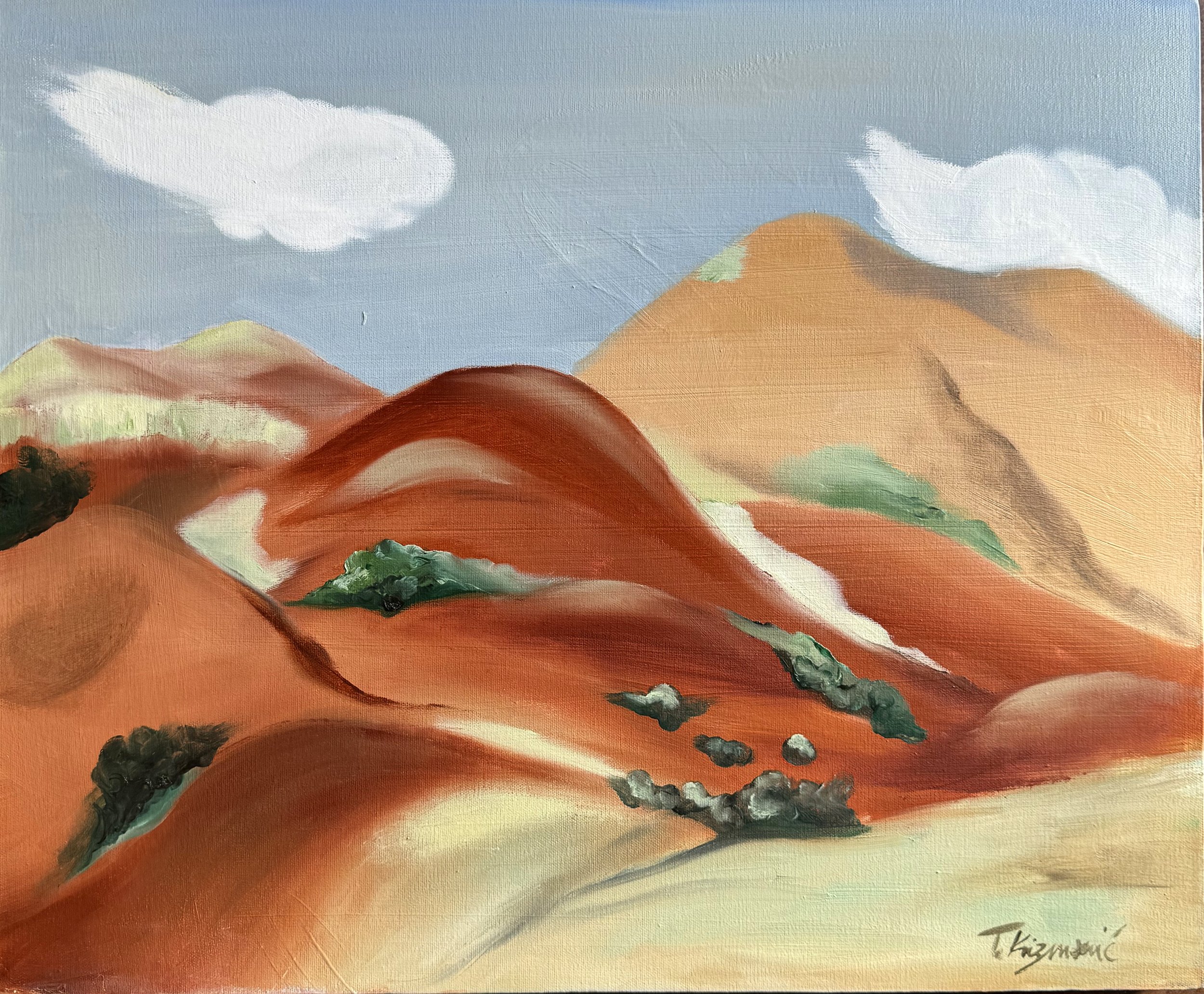
Pilgrim’s Pause, oil on linen, 28” x 32”

The works in Echoes of a Kingdom were created specifically for this occasion, a new series of oil and watercolor paintings inspired by Bhutan’s profound cultural, spiritual and environmental legacy. They are my way of honoring the visionary leadership of His Majesty, who brought the concept of Gross National Happiness into the global consciousness and guided Bhutan through an era of remarkable transformation.

Painting this series has been an act of both homage and gratitude, an attempt to reflect, in color and form, the sense of wonder and connection I feel when I am in Bhutan. The exhibition will be on view at the Wangduechhoeling Palace Museum from September through December 2025, with the opening celebration on September 25.

After its debut in Bhutan, the exhibition will travel to selected cultural venues across Europe and the United States, but to me, Bhutan will always be where this work truly belongs.

Until then, I’ll be here in the studio, brushes in hand, heart full, counting the days.

Sacred Step, oil on birchwood panel, 24” X 18”

Time Passes Slowly

During the winter and early springtime of each year I come to paint in the mountains of Colorado and New Mexico and this year, Utah. The long drive across the United States from the East Coast is magical. Along the way, in this vast beautiful country there are many wondrous landscapes and I’ve often incorporated the elements from the journey into the paintings I work on in my studio in Colorado. It’s endlessly inspiring to touch into the variety of landscapes and deeply connect with the environments and colors of the East, West and Southwest.

Sketches from the League

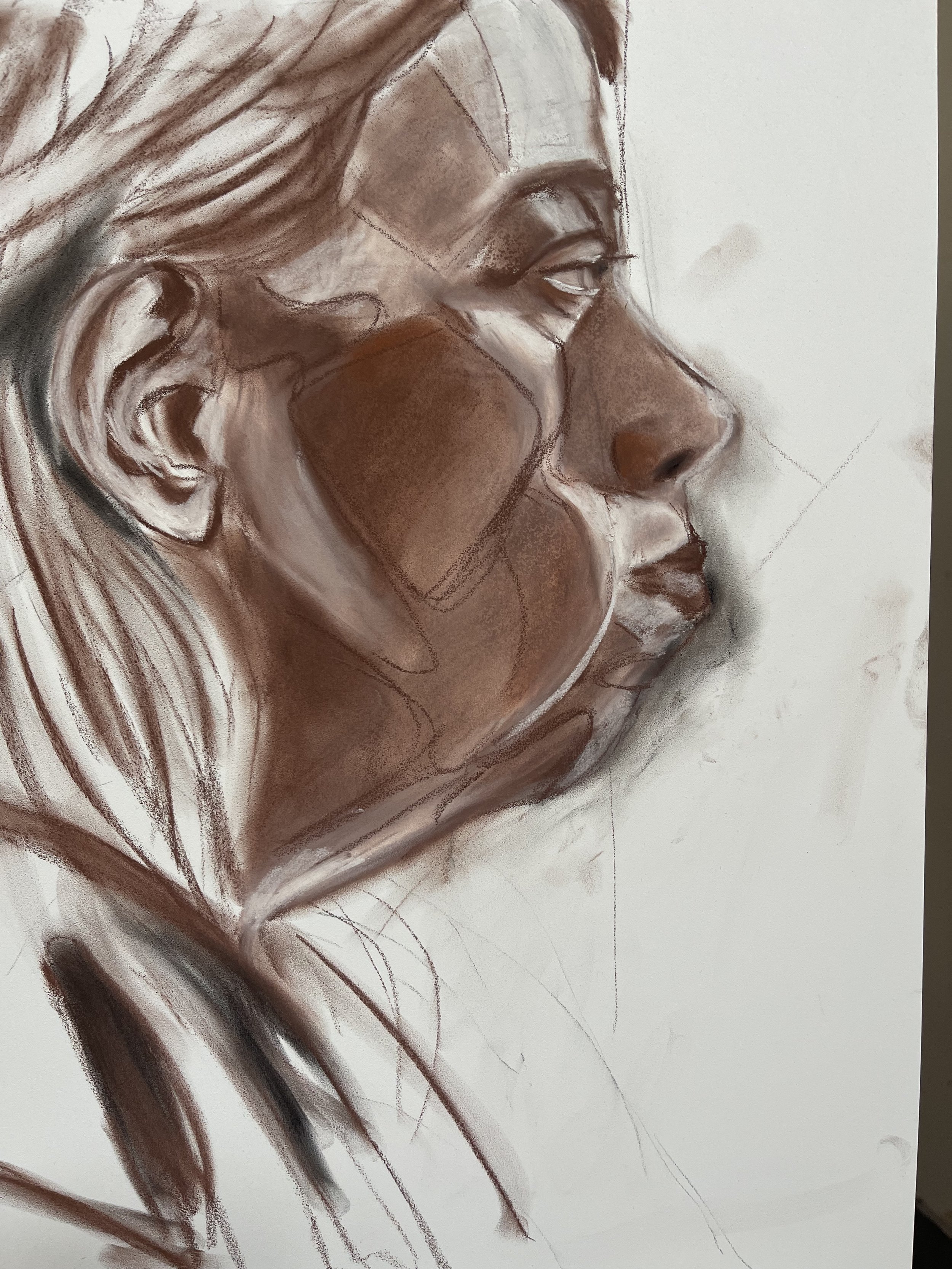
I consider myself an eternal student. I’ve been studying with Max Ginsburg and Sharon Sprung at the Art Student’s League of New York, two realist painters with different approaches. I’m deeply appreciative of the instructions I have received from each of them and of the League as an institution, where visual art in all its many forms is celebrated, nurtured, and preserved.

With the utter luxury of two models per session, it seems almost sinful to find myself gazing at the moments between sittings. Yet what I have loved and observed quietly and absolutely relished are these candid moments of students, teachers and models on break. It’s become a practice of mine to capture them in a photo or a quick sketch and then imagine them as paintings some day in the future.

students on break at the Art Students League of NY